
Archive for the ‘Thoughts on Choosing an Egg Donor’ Category
 I Have A Bee in My Bonnet About Egg Banking
August 2, 2016 | By: Elizabeth
I really shouldn’t be here right now. But there is too much laundry, too many emails, and too many dishes to attend to not to choose to procrastinate right now and get some stuff off my mind. I have had several conversations Today (yes this one specific day on which I am writing) with people entering into “fresh” egg donation cycles and who have debated using or tried using an egg bank. And when I say “fresh” egg donation cycle I mean that they are using an egg donor who will donate all her eggs from one IVF egg donation cycle to the intended parent(s). They have chosen not to use an egg bank. One couple tried using a known donor, then went the egg banking route and are now almost broke and using an egg donation agency and a (wait for it) “fresh” donor. One intended parent was convinced by her IVF Clinic not to waste money on an egg bank and instead choose to use a “fresh” (as in not frozen egg) donor. The others weighed the pros and cons on their own. I also have had the opportunity to discuss it with owners of egg donation agencies (of which, arguably, I am one) and an IVF physician who thinks egg banking and selling eggs is the next best thing to Viagra and sliced bread.
While I recognize the benefit egg banking has for women undergoing medical treatment which may render them infertile or otherwise potentially impair their fertility, or for those who choose to bank their own eggs for their own future efforts at conception, I am NOT a fan of egg banking. So extreme has become my position on this matter than I am working with colleagues on a professional article on the risks women and intended parents are facing by not being properly informed about egg banking.
I get the appeal egg banking presents. It’s faster and easier than using a fresh donor, and very much like the sperm bank experience in terms of selection, anonymity and being one more step removed from the genetic progenitors giving your child life. For some people, I suppose, an egg bank makes alot of sense. But for me, it’s a waste of time and money, risks the future of your family in ways that an egg donation agreement with a fresh donor can provide you (and the donor) protection, and potentially runs afoul of the public policy of most states, insofar as most egg banks provide “x” number of eggs for a set fee and then if you need extra eggs you can “buy” them for “x-thousand” of dollars per egg. Has anyone other than me reviewed the documents egg banks present to consumers and comment on the fact that it is illegal to sell genetic material? And hey, what about the fact that when you have to buy those extra eggs . . . had you used a fresh donor, you might have received the same number of eggs, or more, for an almost equal cost (my client who went through a known donation, an egg bank and is now using an agency would argue the agency was cheaper from the get-go) and without having purchased human tissue (you know human tissue, like a kidney?)??
And what of the success rates? I have yet to see consistent data coming from within my industry that tells me that frozen eggs result in the same number of live births as result from using a fresh egg donor. Egg banks certainly don’t seem to offer the possibility of having frozen embryos from which you might conceive a full genetic sibling. Fresh donor cycles often result in leftover cryopreserved embryos which can be used to conceive additional children. It doesn’t happen for everyone, but it happens for many.
I think the technology is promising. But unless you need to preserve your fertility, I don’t think it is all that it is cracked up to be. And who wants to buy a cracked egg anyway?
I don’t have a lot of time tonight, the dishes smell and the laundry is over-flowing out of three laundry baskets, but I wanted to start this dialogue. I am so sad for my clients who have wasted time, energy, and money not getting pregnant using egg banks.
In the immortal words of Linda Richmond (from SNL) Talk Amongst Yourselves . . . and let me know your thoughts. . . .
Filed under: Current Affairs, Egg Donation, Embryos, Financing Fertility Treament or Adoption, Frozen Embryos, IVF, Personal Musings, The Journey to Parenthood, Thinking Out Loud, Third-Party Assisted Reproduction, Thoughts on Choosing an Egg Donor
Tags: egg bank, egg banking, egg donation agency
Never, Ever Give Up
October 29, 2014 | By: Elizabeth
Today is one of those days where I wish I could make all the hurt and pain go away for one of my clients. For today, everything seems to be falling apart on their path to parenthood. The thing is, I cannot count the number of clients I have had who have been in similar situations — afraid that they had run out of options or run out of money — and we found a way, they perservered for another day and then another day after that until I got the glorious news that they finally had a baby on the way (whether through egg donation, surrogacy or adoption).
With everyone of those clients I refused to give up, I refused to let them give up. Because I have seen so, so many of those “never gonna happen to me/us” situations have a happy ending.
More to the point, I have spoken with so many of those parents who, in the end, were grateful for all the mishaps, all the donors who changed their mind or were screened-out, the changing of surrogates after two failed embryo transfers with only one embryo left . . . whatever the situation was (and there are so many I am not even going to begin to try and describe them all–you know how hard this can be), every single time when I got the call to tell me the joyous news, my client express grattitude for all the mishaps. GRATTITUDE. Because but for those mishaps, they wouldn’t be holding THIS baby, at this moment, and they couldn’t imagine not having THIS baby.
This happened to me too. Had one of our adoptions not been disrupted (as in the baby went back to its birth mother after placement), I wouldn’t have the family I have today. I loved that baby but I love THIS family more.
Whatever happens on your path, whenever you have a crappy-puts-you-over-the-edge-you-can’t-take-it-anymore-this-is-never-going-to-happen-for-me kind of day, remember that tomorrow is a new day with a new opportunity. That there are more options and more choices, you just have to keep looking and putting one foot in front of the other. It may suck today but one day, it might all actually make sense. At the very least, one day you will know that but for all that came before, you wouldn’t be holding THIS baby.
So this my advice for today:
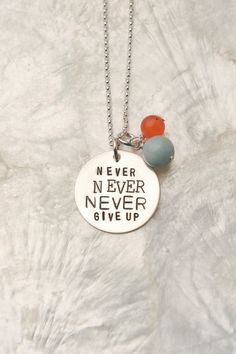
Never, Ever Give Up. At least that’s what the sign above my desk says, and I believe it says it all.
(I like this necklace too)
Filed under: adoption, Age and Infertility, Egg Donation, Faith and Infertility, IVF, Peace to Parenthood, Personal Musings, Surrogacy, Thinking Out Loud, Thoughts on Choosing an Egg Donor
The Bizarre World of Embryo Banking. Where My Motherhood and Morality Meet.
December 7, 2012 | By: Elizabeth
Every once in a while I have true conflicts between my self as a former infertility patient and my career as a reproductive lawyer and adoption attorney. A couple of years ago, I wrote a law review article on the disposition of frozen embryos, and whether or not talking about embryo adoption was legally correct whether the better, more appropriate terminology was/is embryo donation. There are hundreds of thousands of frozen embryos in cryopreservation in this country where the intended parents of those embryos no longer wish to use the embryos for their own family building. These embryos are often referred to as “leftovers” a term which somewhat disturbs me but is strictly speaking, accurate. These embryos are “leftover”, after a family was created through IVF and now remain in a state of frozen suspension. Many of those embryos could be used to help build another family, and be donated to an infertile couple. There was some confusion as to whether these embryos should be placed for adoption or donated in a similar manner to egg and sperm donation and I wanted to resolve that confusion — at least for myself. I ultimately drew the legal conclusion that the term embryo adoption isn’t really accurate because there isn’t a human being to adopt. I could go into a lengthy analysis of how I came to that conclusion but your eyes would roll back in your head and you would probably start drooling from boredom. So let’s just defer that analysis and argument for another day. If you are interested, you can get a copy of the article on the web (click here). I now happen to be a huge advocate for embryo donation. I think it is a fabulous way to build a family. However, these are musings for another blog. But my article did provide some clarity to those medical facilities which are banking those frozen “leftover” embryos.
So here I have been sitting happy as a woman with a barren uterus could ever be, contemplating my holiday shopping safe and secure in my belief in, and advocacy of embryo donation. And then I hear about this doctor in California who has a new kind of embryo bank.
Before I heard of this physician in California, I was aware of only one type of embryo bank; one where frozen “leftover” embryos are being made available for donation to infertile families. These frozen embryos were the subject of my law review article. This new embryo bank, however, does not contain any of these “leftover” frozen embryos. This bank is comprised of embryos which were recently created using carefully selected donor eggs and donor sperm. The donated eggs are fertilized with the donated sperm and the resulting embryos are frozen for future selection by hopeful intended parents. Let’s stop briefly and note emphasis on the words “future selection”. We will circle back to why this is relevant but I wanted to point out that these embryos are being created for future selection by wanna-be-moms and dads.
This physician has created his embryo bank in a manner to facilitate selection for all types of characteristics — everything from physical traits like blond hair and blue eyes to religious ethnicity. Jewish embryos, who knew? Actually, this could be fantastic for Jewish couples who need a single Jewish egg donor, and/or want to further ensure a connection with Judaism by having a genetic connection on the sperm side of life. You have no idea how hard it can be to find a specific ethnic donor and this is something I gather this doctor has identified as a plus to his business model. Speaking of business models, he also offers a money back guarantee. You choose a batch of embryos to use to try and get pregnant. If you don’t get pregnant the first time, you get two more tries using different batches of embryos. If you don’t get pregnant, you get 100% of your money back (approx. $12,000).
Upon hearing of this embryo bank a part of me was disgusted and a part of me . . . well I was excited. Super excited. Especially about the money back guarantee.
The infertility patient part of me sees this as a great opportunity to get pregnant. Frozen embryo transfers — while statistically less successful than fresh embryo transfers — can be lot easier to go through than an IVF cycle. For me having the embryos created using donor gametes isn’t a big deal. But if it were, I would be able to select an embryo based on whatever I might deem important. So, yeah baby! Let’s have another baby! Give me this doctor’s number. I am in! Or perhaps it would be better to say the embryos are [going to be] in [me]!
But the legal scholar, academic, intellectual, lawyer part of my brain is sitting here vomiting and is pissed that I am putting these thoughts onto cyber-paper and making an argument in favor of this horrific new kind of embryo bank. Stork Lawyer Reality check: It is pretty much illegal to create embryos without first having identified intended parents as recipients for those embryos and from what I understand, there are no intended parents waiting for those embryos when this doctor is creating them. The intended parents don’t enter the picture until the embryos are selected from the database and someone signs up with this program to undergo an embryo transfer procedure. This is where that whole “future selection” comes in.
The laws regarding assisted reproduction essentially come down to intent to parent before conception: in a third party assisted reproductive arrangement there is supposed to be a contract or other document signed before the embryos are created, whereby intended parent(s) agree to be legally and morally responsible for the embryos and children that may result from the ART process. In this case there is no such contract or preexisting intended parent. The embryos subject of my law review article all had intended parents before the egg and sperm came together to create the now frozen “leftover” embryo. But this new type of embryo banking lacks that component. There are no intended parents choosing the eggs and the sperm with the immediate intent to parent.
And speaking of all those “leftover” embryos shouldn’t we first be dealing with and using all the existing cryopreserved embryos before we go about creating them? And what about the potential that this doctor may be creating even more “leftover” frozen embryos (what happens to those embryos that don’t get selected)?
Let’s not analyze whether this is baby selling. I can’t, or won’t go there, although many others have. Consanguinity, or the risk of an individual created through donor gametes marrying or having a child with a genetic sibling is another issue that has been raised. The number of families that are created using any individual egg or sperm donor’s genetic material is a concern not to be overlooked or ignored. These donors presumably are also donating through egg donation agencies, fertility clinics or sperm or egg banks. We all have been astonished by stories of men who have discovered that they have fathered over a 100 children as a result of their donation to sperm banks — there is a significant risk that through this new type of embryo banking program not only will children have multiple full siblings running around but that egg and sperm donors have created half siblings through other programs.
Even more, if I understand this program correctly (and I am pretty sure I do) batches of embryos are being created which contain embryos which are full siblings to embryos which are contained in other or separate batches of embryos. It sounds like it is possible that three separate donations could take place using these three batches of embryos. Okay, follow-me slowly here for a minute because this is a little bit like playing Twister. In other words, three batches of embryos each of which contain embryos which are full genetic siblings to embryos in other batches, could be donated to three different families thereby creating three separate families whose children are all full genetic siblings to each other!
Do the recipients of these embryos know how many full genetic siblings their child may have? Are the donors aware?
It is supposedly almost impossible from a statistical standpoint for one of these children to marry its full sibling. But when you add in the half siblings that could be created through other donation programs, and/or smaller ethnic groups for whom donation can be a challenge because of the limited number of donors available matching their ethnicity, doesn’t the risk become somewhat more than insignificant? And even if it doesn’t, I worry that people don’t have enough information about how many genetic siblings are out there whether they are full or half siblings.
But I get it, I get why he did it. Especially for someone with an ethnic background this type of program would be hugely popular and let’s not forget the money back guarantee. We’re all broke after trying IVF multiple times, why the heck not take out a second mortgage if you know you will be able to pay it back if you don’t get pregnant? Sounds pretty good doesn’t it?
I am at war with myself. I want to go running to that clinic and pick out an embryo tomorrow. And then my lawyer (self) tells me to stop and think about whether I want to participate in, and thereby endorse a practice which I believe, in my own legal opinion, is legally impermissible, and legally and medically unethical. Is my desire to be a gestational mother stronger than my moral center? Good question.
The views expressed in this blog are the views and opinions of this author and are not intended to provide or constitute legal advice or a statement of the laws as they may pertain third-party assisted reproduction within the United States.
Filed under: adoption, Check This Out, Current Affairs, Egg Donation, Financing Fertility Treament or Adoption, In the News, IVF, known sperm donation, Personal Musings, The Journey to Parenthood, Third-Party Assisted Reproduction, Thoughts on Choosing an Egg Donor, Uncategorized
Tags: adoption, Economy, Egg Donation, egg donor, Finances, financing, infertility, intent, IVF, success, The Stork Lawyer


